
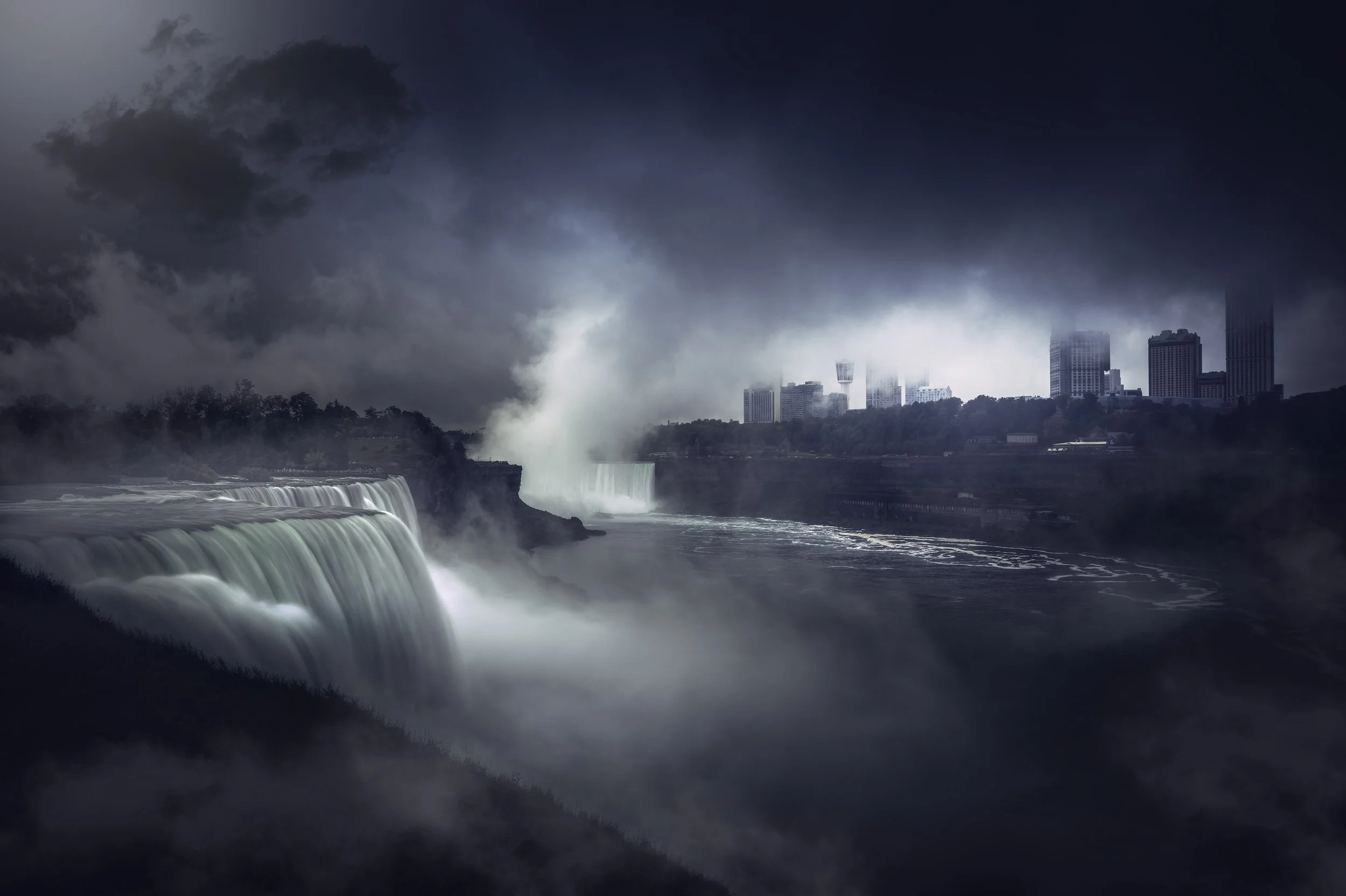
“FOUNTAIN IN THE MIST”
“I will rivers on the bare heights, and fountains in the midst of the valleys. I will make the wilderness a pool of water, and the dry land springs of water.” Isaiah 41:18
American Falls lies entirely within U.S. territory. Wedged between Prospect Point and Luna Island, it’s fed by the Niagara River. Its striking green hue originates from dissolved salts and finely ground sediment picked up from its limestone bed—a visible testament to water’s erosive power. An estimated sixty tons of dissolved minerals, in conjunction with 4.5 million gallons of water, cascade over American Falls every minute. Which is only ten percent of Niagara’s total flow from all three falls.
Niagara Falls, New York: 2024

“MEMORY MAKER”
Since 1939, this dock has been a launchpad for adventurers, entrepreneurs, and visionaries—a place where dreams took flight, resolutions solidified, and new paths, forged. Welcome to the gateway to boundless opportunities.
Lake McDonald, Glacier National Park, Montana: 2014

“ROADSIDE TREASURE”
It always pays dividends to take the path less traveled.
Woodruff, Utah: 2016
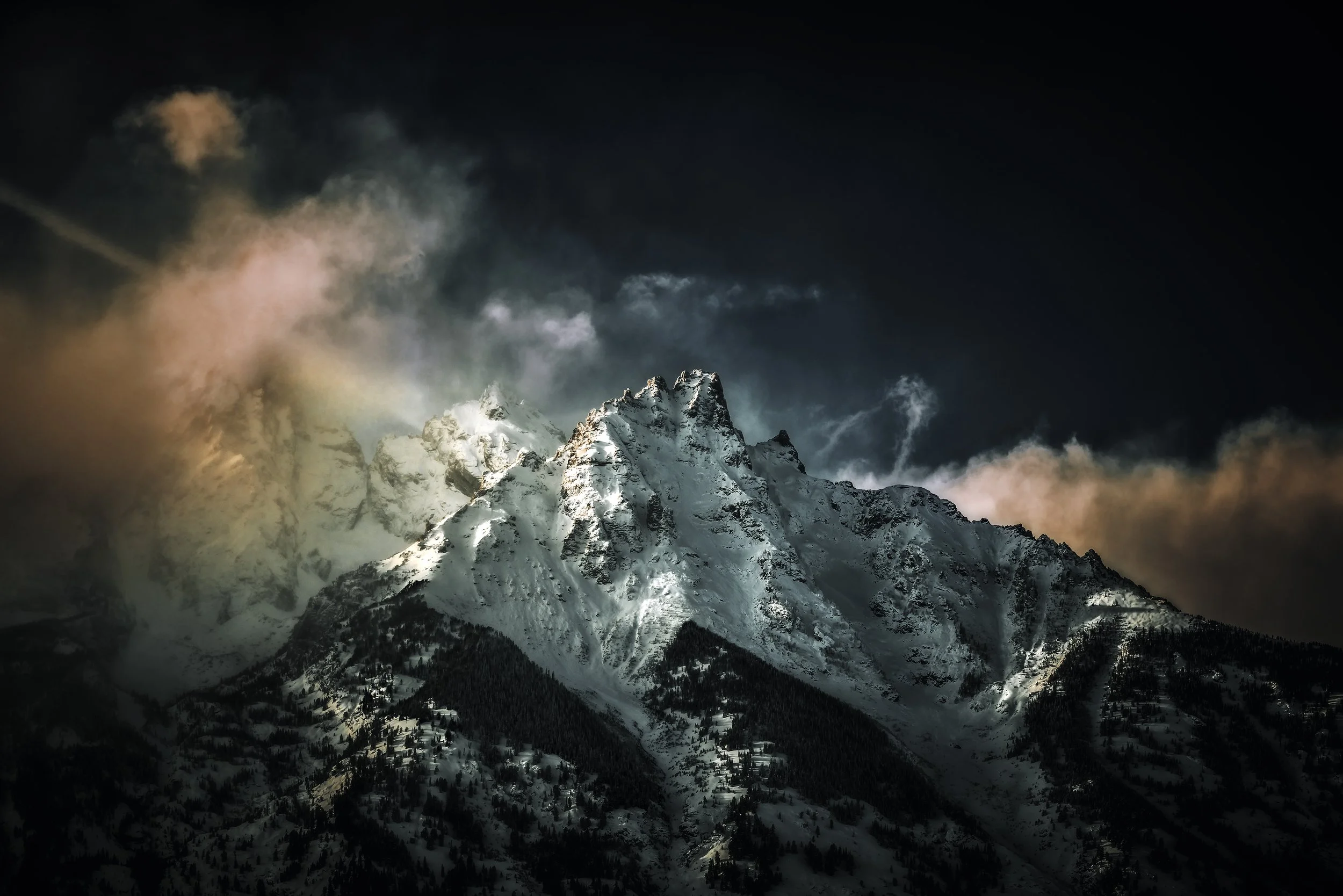
“THE STRUGGLE FOR DOMINANCE”
Teewinot Mountain momentarily dominates the horizon as Grand Teton desperately battles relentless, low-lying clouds infused with a unique last light, insinuating a millennial-long rivalry over elevational superiority.
Jackson, Wyoming: 2016

“GUARDIAN OF THE GARDEN”
The majestic Tetons stand guard and maintain over-watch for one of the Pacific Northwest’s most vital waterways—the Snake River—providing sustenance from the Continental Divide to the Columbia River.
Moose, Wyoming: 2017

“GRAND REVELATION”
The morning began eclipsed by cloud cover, but the Tetons soon broke free, showcasing their palatial peaks, marveling at their own reflected beauty in the Snake River below.
Schwabacher Landing, Wyoming: 2017

“THIRTY-YEAR ICON”
In 1910, Thomas Alma settled into Mormon Row, positioning his homestead just south of his brother John’s. However, it took Thomas nearly three decades to complete his now-iconic barn. In the mid-twentieth century, Grand Teton National Park incorporated Mormon Row and added Thomas’ barn to the National Register of Historic Places in 1997.
Grand Teton National Park, Wyoming: 2018

“SEVENTY-SIX-YEAR REMIX”
A photographic nod to one of the all-time greats, Ansel Adams who captured his iconic image named The Tetons and the Snake River from this very spot in 1942. Seventy-six years earlier.
Grand Teton National Park, Wyoming: 2018

“JACKSON LAKE LIGHTS”
At 6,772 feet above sea level, Jackson Lake is among the largest high-altitude lakes in the U.S., and perfectly positioned to snag first dibs on sunrise.
Jackson Lake, Wyoming: 2018

“PATH TO PARADISE”
Ribbon Creek, blanketed by winter’s first snowfall, provides a natural, framed pathway to one of Yosemite National Park’s greatest gifts—El Capitan.
Yosemite National Park, California: 2018

“WIND BLOWN”
Two hundred and seventy-five square miles of glistening white gypsum sand dunes undoubtedly establish White Sands National Park as one of the world’s great natural wonders.
White Sands National Park, New Mexico: 2018

“DIAMOND IN THE ROUGH”
Built by the Canadian Pacific Railway, Emerald Lake Lodge was, and remains, the sole property on Emerald Lake. Nestled within Yoho National Park and surrounded by the breathtaking Canadian Rocky Mountains, this remote location has been a launching pad for tourists to experience Canada’s natural beauty, abundant wildlife, and endless possibilities for outdoor adventure since 1902.
Emerald Lake, British Columbia: 2019

“MORNING HAZE”
Vermilion Lakes are located just west of Banff, Alberta, within the Canadian Rocky Mountains. The third lake is notable for its hot spring, which contributes to a stunning hazy glow in this striking sunrise landscape.
Banff, Alberta: 2019

“LASSO THE MOON”
Under an ethereal full moon, Mount Rundle stands silhouetted, looming over the Fairholme Range. Vermilion Lake reflects the celestial display above on its shimmering, ice-covered surface.
Banff, Alberta: 2019

“STUMPED AT SPRAY LAKES”
The Spray Lakes reservoir is a tributary of the Bow River. Positioned nearly one mile above sea level, used for hydroelectric power.
Spray Valley Provincial Park, Alberta: 2019

“THE REVENANT”
Mount Nestor stands parallel to the Spray Lakes Reservoir and boasts an elevation of 9,740 feet. It’s named in honor of HMS Nestor, a destroyer sunk during the Battle of Jutland in World War I. The mountains base served as the cinematic backdrop for Fort Kiowa in The Revenant, a critically acclaimed film loosely based on a true survival story of nineteenth-century frontiersman and fur trapper Hugh Glass, who was brutally mauled by a grizzly bear in 1823 and left for dead by his companions.
Canmore, Alberta: 2019

“DAWSON’S PEAK”
In 1884, George Mercer Dawson named it Storm Mountain after enduring several days of storms while camping below it. This unique Banff National Park ridge line peaks at 10,361, and straddles the continental divide between Alberta and British Columbia.
Banff National Park, Alberta: 2019

“ATLANTIC VIEW”
Julian Morton, of the same family that owned Grandfather Mountain, originally built the Atlantic View Pier in 1930. Then sold it to Johnny Mercer in 1939, who renamed it after himself. Over its history, Johnny Mercer Pier has weathered several significant storms, including Hurricane Hazel in 1954. However, in 1996, it was Fran and Bertha that ultimately led to the wooden structure’s demise. Now rebuilt, it stands as North Carolina’s first concrete pier, stretching twelve hundred feet into the Atlantic Ocean and engineered to withstand winds up to two hundred miles per hour.
Wrightsville Beach, North Carolina: 2019